5-46KV SHIELDED POWER CABLE FOR USE IN THE TRANSMISSION AND DISTRIBUTION OF ELECTRIC ENERGY

ICEA S-93-639 is a standard developed by the Insulated Cable Engineers Association (ICEA) and simultaneously adopted by the National Electrical Manufacturers Association (NEMA) as WC 74. This standard holds significant authority within the North American and global power engineering sectors. It serves as the core technical document guiding the manufacture, testing, and application of 5kV to 46kV shielded medium voltage power cables.
1. Scope and Voltage Ratings
ICEA S-93-639 is specifically designed for shielded power cables used in electrical energy transmission and distribution.
Special Environmental Notes: Specific appendices (e.g., Appendix K) provide detailed requirements for cable qualification and design characteristics under wet conditions (such as direct burial in moist environments or underwater). This is particularly critical for power grid construction in high-humidity areas or underwater applications.
Voltage Ratings: Covers voltage levels from 5,000 volts to 46,000 volts (5kV to 46kV).
Application Scenarios: The standard accounts for normal conditions of installation and operation, covering a very wide range of applications including indoor, outdoor, direct burial, duct, aerial, underground duct, and even underwater (including submarine) installations.
2.Insulation Materials
The standard explicitly defines two primary insulation material systems to suit different operating environments:
- Cross-Linked Polyethylene: Includes both standard XLPE and Tree-Retardant Cross-Linked Polyethylene. This material offers excellent electrical properties and heat resistance, with a maximum allowable continuous operating temperature typically of 90°C and an emergency short-circuit rating of 250°C.
- Ethylene Propylene Rubber: EPR insulated cables are also covered under this standard and are often preferred in projects requiring specific flexibility or particular aging characteristics.
3.Cable Construction
Standard Cable Construction Layers (from inside to outside)
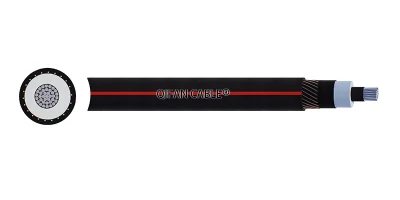
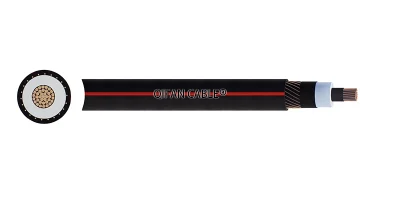
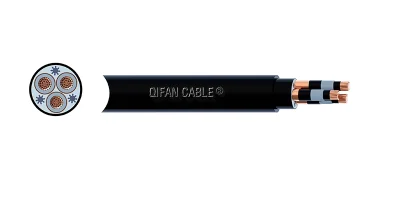
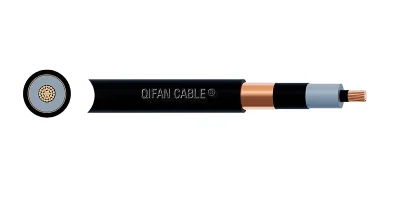
A cable strictly conforming to ICEA S-93-639 typically consists of the following layers:
Table 1:
| No. | Layer | Key Materials/Requirements | Function |
|---|---|---|---|
| 1 | Conductor | Stranded bare or tinned copper, Class B stranding (per ASTM B3/B8) | Current-carrying core for power transmission |
| 2 | Conductor Shield (Inner Semi-conductive Layer) | Extruded semi-conductive material | Smooths the electric field at the conductor surface; prevents discharge at conductor-insulation interface |
| 3 | Insulation | XLPE ,TR-XLPE or EPR | Primary dielectric for voltage withstand; 90°C continuous (250°C short-circuit) |
| 4 | Insulation Shield (Outer Semi-conductive Layer) | Semi-conductive tape or extruded semi-conductive layer | Smooths the electric field on the outer surface of the insulation |
| 5 | Metallic Shield | Copper tape, brass tape, or tinned copper braid | Carries fault current; provides electromagnetic shielding |
| 6 | Jacket | PE, PVC, CPE, etc. | Mechanical protection; weather and corrosion resistance |
Tabls: 2 Insulation Levels According to ICEA S-93-639
Based on system grounding method and fault clearing time, ICEA S-93-639 divides cable insulation levels into three categories: 100%, 133%, and 173%.
The definitions, typical applications, and relative relationships of these three levels are shown in the table below:
| Insulation Level | Core Definition & Fault Clearing Time | Typical Application System | Relative Insulation Thickness |
|---|---|---|---|
| 100% Level | Fault cleared within 1 minute. Applicable where protection systems operate quickly and reliably. | Solidly Grounded Systems | Baseline (minimum thickness) |
| 133% Level | Fault clearing time exceeds 1 minute but does not exceed 1 hour. Applicable where faults cannot be cleared immediately but will eventually be isolated. | Impedance-Grounded Systems, or systems with delayed protection operation | Thicker than 100% level |
| 173% Level | Fault clearing time is not fixed; faults may persist for extended periods. Designed for the most severe applications, providing maximum insulation protection. | Ungrounded Systems, Resonant Grounded Systems | Thickest (highest dielectric stre |
Table 3: Jacket Materials and Applicable Environments
| Jacket Material | Characteristics | Recommended Installation Environment |
|---|---|---|
| PVC (Polyvinyl Chloride) | General purpose, lower cost | Conventional indoor / outdoor |
| PE (Polyethylene) | Excellent moisture and water resistance | Direct burial, wet environments, underwater |
| CPE (Chlorinated Polyethylene) | Oil resistant, abrasion resistant, weather resistant | Industrial environments, outdoor |
| XLPE (Cross-linked Polyethylene) | Superior heat resistance | High temperature operating environments |
Tabvle 4: Typical Application Construction Example — FAA L-824 Type C (Airport Lighting Cable)
This type references ICEA S-93-639 and has the following construction:
| Layer | Material |
|---|---|
| Conductor | Stranded bare copper or tinned copper |
| Conductor Shield | Extruded semi-conductive material |
| Insulation | XLPE |
| Insulation Shield | Semi-conductive tape or extruded semi-conductive layer |
| Metallic Shield | Copper tape / brass tape (tinned copper braid optional) |
| Jacket | PVC (PE / XLPE optional) |
Need help?
WhatsApp:
Email:
Leave a Message
Please provide your contact details.
ICEA S-93-639 Cable
FAQ
Answers To Your Most Common Questions
Find quick answers to common questions below.
Answer:
XLPE (Cross-linked Polyethylene)
TR-XLPE (Tree retardant crosslinked polyethylene)
EPR (Ethylene Propylene Rubber)
Answer: ICEA S-93-639 cover 5kV, 8kV, 15kV, 25kV, 28kV, 35kV and 46kV.
Answer:
1. To Carry Short-Circuit Current (Fault Current Capacity)
The metallic shield is designed to provide a low-impedance return path for fault currents. When an insulation failure occurs, the metallic shield safely conducts the resulting current back to the source, allowing protection devices (e.g., circuit breakers, fuses) to operate and clear the fault without damaging the cable insulation or conductor.
2. To Provide Electromagnetic Shielding (Electric Field Confinement)
The metallic shield confines the electric field within the cable. It ensures that:
The electric field does not radiate outward, preventing electromagnetic interference (EMI) with adjacent communication cables (e.g., control, instrumentation, or data cables) or electronic equipment.
The outer surface of the insulation shield is maintained at or near zero potential (ground potential), creating a safe and interference-free external environment around the cable.
Get In Touch
Let’s Build Something
Together.
Our team of multilingual sales professionals and technical specialists are on hand to support you with your cable projects, from specification through to installation. Please use the contact details below to get in touch.
Quick Link