CU/XLPE/PVC/AWA/PVC 0.6/1kV Single core armored cable
Single core XLPE insulated PVC sheathed armored cable with copper conductor
Application:
To be used for main power supply such as in low voltage distribution power networks, indoor and outdoor areas. It can be installed in ducts, in dry or wet locations, recommended for direct burial where require higher electrical and mechanical protection.
Standard:
- Cable design: IEC 60502-1 or AS/ZNS 5000.1
- Conductor: IEC 60228 or AS/ZNS 1125
Construction
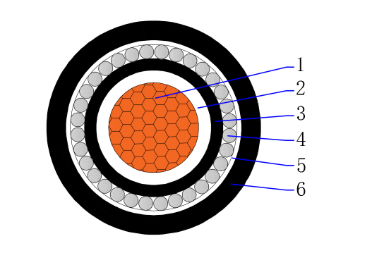
- 1. Conductor – Plain annealed class 2 stranded (compacted) copper
- 2. Insulation – Cross linked polyethylene (XLPE)
- 3. Inner sheath – Polyvinyl chloride compound (PVC)
- 4. Armor – Hard drawn aluminum wires
- 5. Binder tape – Non-hygroscopic material tape
- 6. Outer sheath – Polyvinyl chloride compound (PVC)
Cross Section:
- 1C1.5~1C800mm2
Temperature characteristics:
- Conductor operating temperature: -15℃~90℃
- Min. temperatrue laying condition: 0℃
- Conductor emergency operating temperature: 105℃
- Conductor short-circuit operating temperature (5s): 250℃
Electrical Characteristics:
- Rated voltage: 0.6/1 (1.2) kV
- High voltage test: 3.5kV / 5min
Color:
- Insulation: According to customer requirements
- Outer sheath: Black or according to customer requirements
Minimum Bending Radius:
| Items | Single-core Cables | Three-core Cables | ||
| Unarmoured | Armoured | Unarmoured | Armoured | |
| Min. bending radius during installation | 20D | 15D | 15D | 12D |
| Min. bending radius close to connection box and termination (bending radius should be controlled carefully, if the molding guide plate is used) | 15D | 12D | 12D | 10D |
Applicable Standards
Optional
Technical Parameters
| No. of cores and nominal cross section | Min. Number of wires | Nominal insulation thickness | Nominal | Nominal | Approx. | Approx. weight | Max. DC resistance of conductor |
| Non-magneticsteel wire diameter | sheath thickness | overall Diameter | at 20℃ | ||||
| No.× mm2 | No. | mm | mm | mm | mm | kg/km | Ω/km |
| 1×10 | 6 | 0.7 | 0.8 | 1.4 | 12.1 | 322 | 1.83 |
| 1×16 | 6 | 0.7 | 0.8 | 1.4 | 12.9 | 397 | 1.15 |
| 1×25 | 6 | 0.9 | 0.8 | 1.4 | 14.5 | 526 | 0.727 |
| 1×35 | 6 | 0.9 | 0.8 | 1.4 | 15.5 | 642 | 0.524 |
| 1×50 | 6 | 1 | 1.25 | 1.5 | 18.1 | 920 | 0.387 |
| 1×70 | 12 | 1.1 | 1.25 | 1.5 | 19.8 | 1181 | 0.268 |
| 1×95 | 15 | 1.1 | 1.25 | 1.6 | 21.8 | 1488 | 0.193 |
| 1×120 | 18 | 1.2 | 1.6 | 1.7 | 24.3 | 1922 | 0.153 |
| 1×150 | 18 | 1.4 | 1.6 | 1.7 | 26.2 | 2253 | 0.124 |
| 1×185 | 30 | 1.6 | 1.6 | 1.8 | 28.4 | 2705 | 0.0991 |
| 1×240 | 34 | 1.7 | 1.6 | 1.9 | 31.1 | 3343 | 0.0754 |
| 1×300 | 34 | 1.8 | 1.6 | 2 | 33.7 | 4011 | 0.0601 |
| 1×400 | 53 | 2 | 2 | 2.1 | 38.3 | 5273 | 0.047 |
| 1×500 | 53 | 2.2 | 2 | 2.2 | 41.8 | 6426 | 0.0366 |
| 1×630 | 53 | 2.4 | 2 | 2.3 | 46.1 | 7990 | 0.0283 |
FAQ
What is the difference between AWA and SWA? A single core armoured cable will always have a layer of aluminium wire armour (AWA) instead of steel wire armour (SWA). This is because the steel in SWA has a much lower conductivity – and therefore higher resistance – than aluminium.
AWA cable, short for Aluminium Wire Armoured cable, features aluminium wires as the armouring layer. It’s mainly used in single-core cables for high voltage installations. The aluminium wire helps prevent magnetic interference, making it safer and more effective in those setups.
Aluminum Wire Armoured
AWA (Aluminum Wire Armoured): Used for single-core cables to prevent magnetic hysteresis losses, often in AC systems.
What are the disadvantages of armored cable?
For starters, it’s heavier than most types of cable. The presence of a metal sheath adds weight to armored cable. In addition to weighing more than other types of cable, armored cable is less flexible. It can’t bend or flex as easily as PCV-sheath cable.
XLPE (cross-linked polyethylene) cables offer excellent thermal and electrical performance, but their primary disadvantages include a higher initial cost (30%-50% more than PVC), increased rigidity that limits their bending radius, and high susceptibility to physical damage from impact or abrasion during routing.
Armoured cables are low-voltage (LV) power or control cables that are designed for use in mains supply at a maximum 600/1000 V. As the name suggests, armoured cables act as bodyguards for electrical circuits.