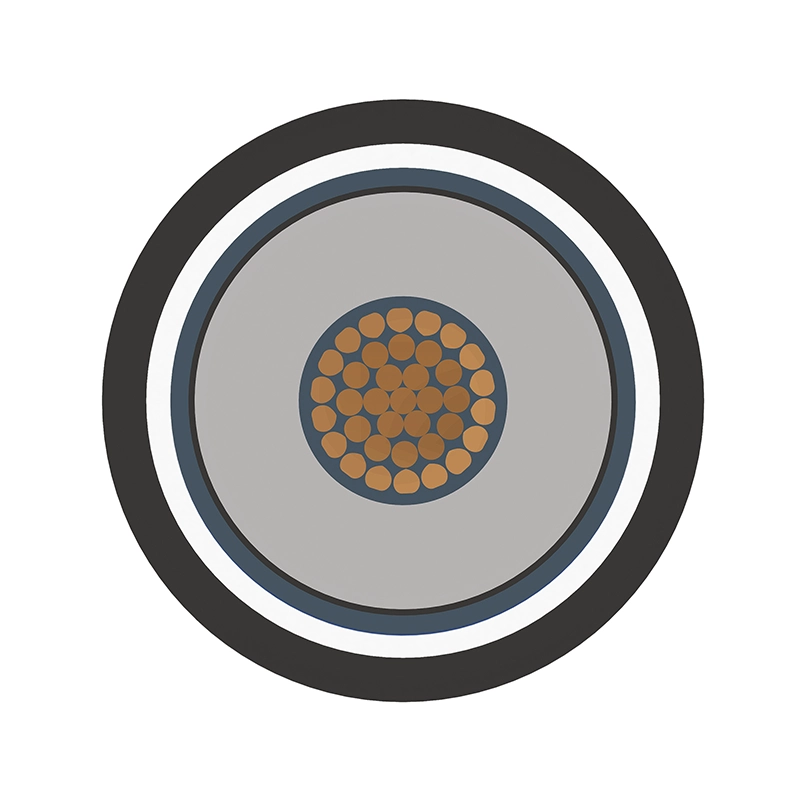

Application
The products are mainly complying with IEC 60840 standard, also can be produced according to OEM requirements and other standards, such as bs standard, DIN standard, ASTM standard, etc.
Voltage grade is up to 220kv, cross-section area can be up to 2500 sqmm (copper or aluminiun conductor). Conductor long-time operating temperature is 90 degrees. In short circuit, conductor highest temperature should be not more than 250 degrees.
Characteristics
- Voltage Rating: 66kV,110kV,132V,220kV
- Max. conductor temperature in service 90 °C
- Max. Short time overload temperature(2 h)130 °C
- Maximum conductor short time temperature 250 °C
- Bending factor when laying
- 20 x D single core cable
- Metallic Screen: Copper wire
Products Construction
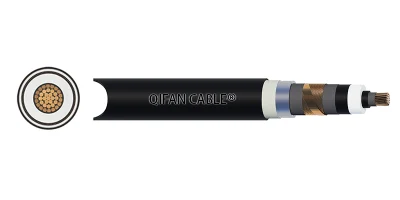
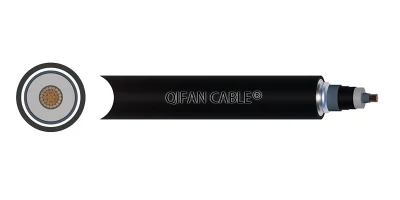
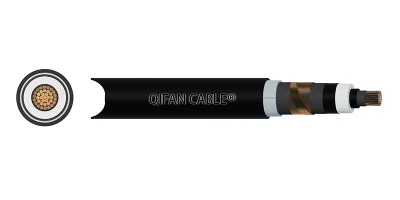
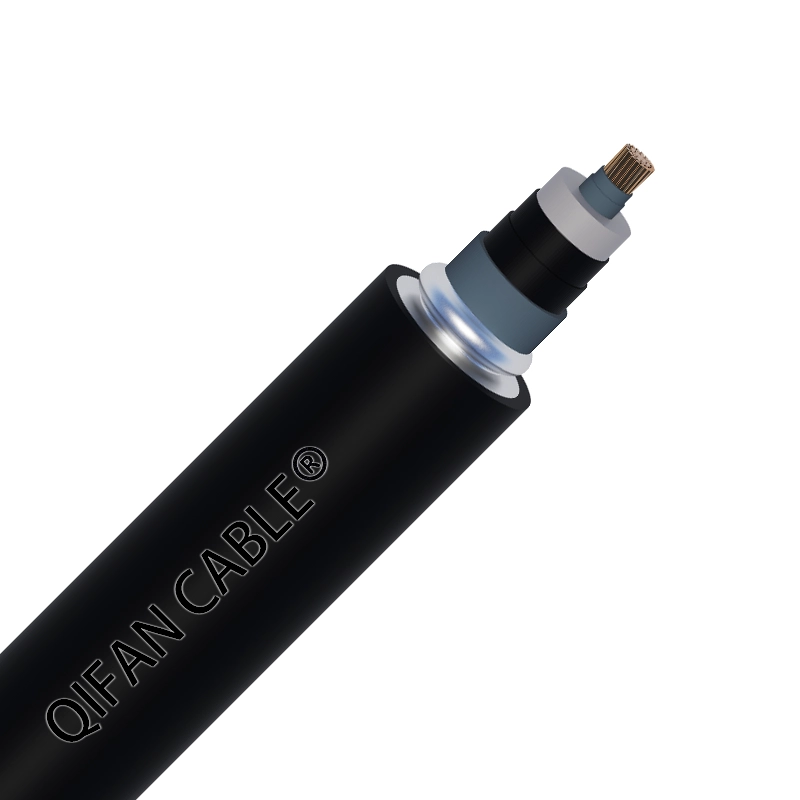
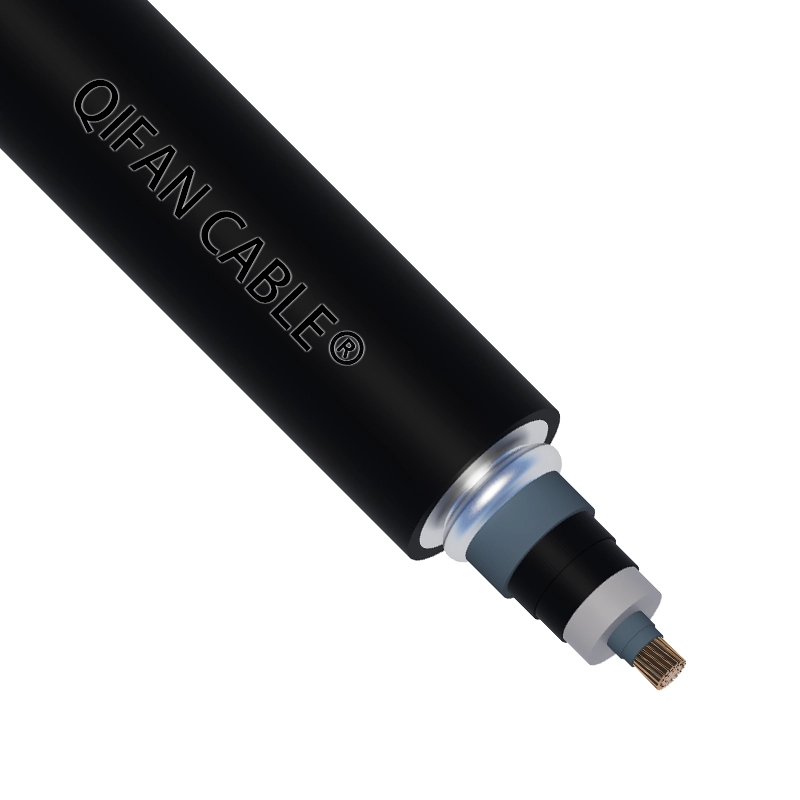
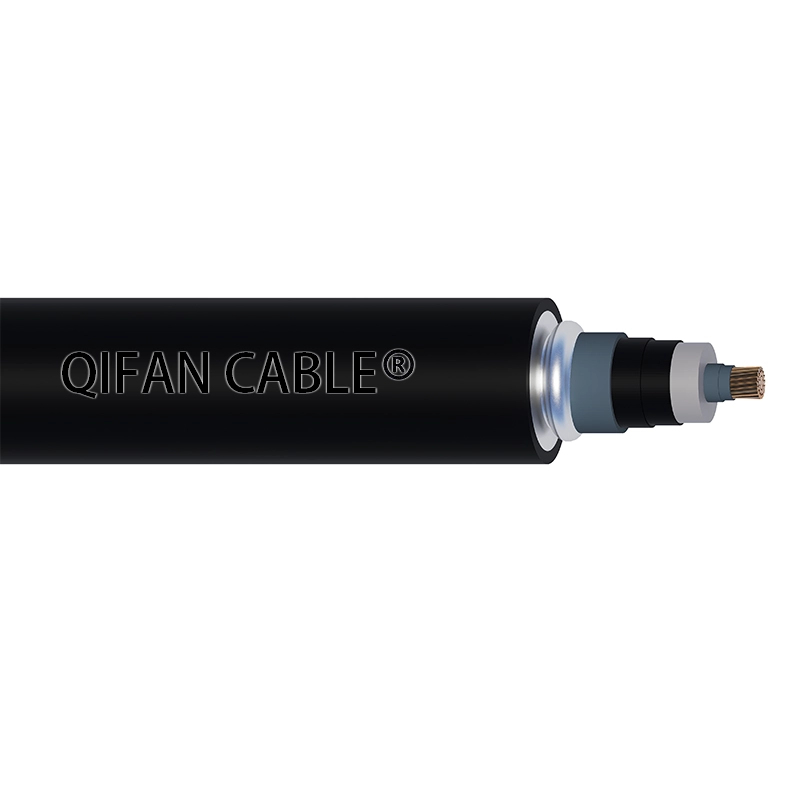
Copper or aluminium conductor
Conductor screen
XLPE insulation
Insulation screen
Copper Wire Screen
PVC or PE sheath
Applicable Standards
Optional
Technical Parameters
| Nominal cross section (mm²) | Conductor shape | Conductor diameter (mm) | Nominal insulation thickness (mm) | Insulation outer diameter (mm) | Copper-wire screen cross section (mm²) | Nominal sheath thickness (mm) | Overall nominal outer diameter (mm) | Approx. mass YJV (kg/km) | Approx. mass YJY (kg/km) | 20℃ conductor DC resistance (Ω/km) | Cable capacitance @20℃ (μF/km) |
| 1×240 | Circular compact conductor | 18.4 | 19.0 | 59.2 | 95 | 4.0 | 74.4 | 6996 | 5535 | 0.0754 | 0.130 |
| 1×300 | Circular compact conductor | 20.6 | 18.5 | 60.4 | 95 | 4.0 | 75.6 | 7621 | 5777 | 0.0601 | 0.141 |
| 1×400 | Circular compact conductor | 23.4 | 17.5 | 61.2 | 95 | 4.0 | 76.4 | 8370 | 6007 | 0.0470 | 0.167 |
| 1×500 | Circular compact conductor | 26.6 | 17.0 | 63.4 | 95 | 4.0 | 78.6 | 9472 | 6440 | 0.0336 | 0.182 |
| 1×630 | Circular compact conductor | 30.0 | 16.5 | 65.8 | 95 | 4.5 | 82.0 | 10840 | 6960 | 0.0283 | 0.201 |
| 1×800 | Circular compact conductor | 34.0 | 16.0 | 68.8 | 95 | 4.5 | 85.0 | 12574 | 7618 | 0.0221 | 0.213 |
| 1×800 | Segmented conductor | 35.0 | 16.0 | 71.1 | 95 | 4.5 | 87.3 | 12860 | 7904 | 0.0221 | 0.224 |
| 1×1000 | Segmented conductor | 39.0 | 16.0 | 75.1 | 95 | 4.5 | 91.3 | 15206 | 8988 | 0.0176 | 0.252 |
| 1×1200 | Segmented conductor | 42.6 | 16.0 | 76.7 | 95 | 5.0 | 95.9 | 17370 | 10007 | 0.0151 | 0.268 |
| 1×1400 | Segmented conductor | 45.2 | 16.0 | 81.3 | 95 | 5.0 | 98.5 | 19369 | 10769 | 0.0129 | 0.282 |
| 1×1600 | Segmented conductor | 48.5 | 16.0 | 84.6 | 95 | 5.0 | 101.8 | 21338 | 11563 | 0.0113 | 0.295 |
| 1×1800 | Segmented conductor | 50.8 | 16.0 | 86.9 | 95 | 5.0 | 104.1 | 23249 | 12112 | 0.0101 | 0.306 |
| 1×2000 | Segmented conductor | 54.0 | 16.0 | 90.1 | 95 | 5.0 | 107.3 | 25540 | 13166 | 0.0090 | 0.322 |
| 1×2200 | Segmented conductor | 57.4 | 16.0 | 93.5 | 95 | 5.0 | 110.7 | 27607 | 13995 | 0.0083 | 0.335 |
| 1×2500 | Segmented conductor | 61.2 | 16.0 | 97.3 | 95 | 5.0 | 114.5 | 30597 | 15129 | 0.0072 | 0.350 |
FAQ
A high-voltage wire (or cable) is an electrical conductor rated to carry high potential energy, typically above 1,000 volts (though often running from 35 kV to over 500 kV). These heavy-duty cables are designed to efficiently transmit massive amounts of electricity from power plants to municipal grids while minimizing energy loss
Depending on application needs, high voltage cable typesinclude PVC (Polyvinyl Chloride) and XLPE (Cross-Linked Polyethylene) insulated cables. Among them, XLPE power cables are the most widely used due to their superior thermal and dielectric properties, making them suitable for demanding environments.
A high-voltage cable (HV cable), sometimes called a high-tension cable (HT cable), is a cable used for electric power transmission at high voltage. A cable includes a conductor and insulation. Cables are considered to be fully insulated.
Voltage Levels – HV systems operate above 1,000 volts, while LV systems stay below. Capacity – HV can handle significantly higher loads, ideal for energy-intensive operations. Infrastructure – HV requires more robust equipment, including larger switchgear and more complex cabling, than LV systems.
The most common materials used in HV cables are copper and aluminum. Most applications favor a copper conductor because stranded copper wire is very flexible and an excellent conductor. Aluminum is lighter weight and less costly, but it has a slightly lower conductivity.
Neutral lines are commonly used in low-voltage distribution systems, but not in high-voltage transmission. Here’s why: In electrical systems, the term neutral typically refers to a point in the circuit that is at zero potential relative to the ground. The neutral wire serves as a return path for current.