8.7/10kV-290/500kV XLPE insulated with or without Optical fiber Submarine cable
Application:
This submarine cable is used for connecting between land islands, crossing rivers or harbors, connecting drilling platforms from land or connecting drilling platforms to each other, etc. Single-core submarine cables are often used for large island connections for permanent populations, large capacity transmission across rivers and straits. Three-core submarine cables are often used for island power supply and offshore wind turbines.
Standard:
- Cable design: JB/T11167、IEC63026
- Conductor: GB/T 3956, IEC 60228
Products Construction
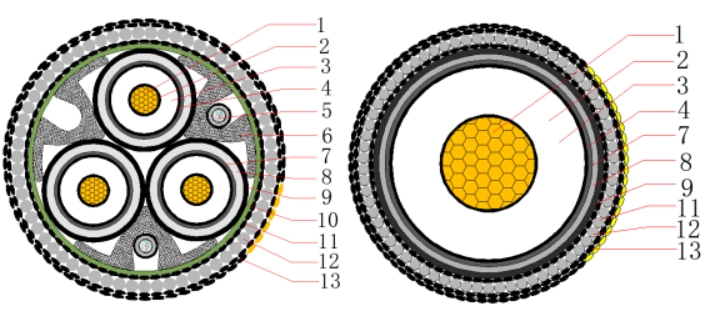
- Conductor – Plain annealed class 2 circular compacted conductor copper conductor
- Conductor screen – Semi-conductive compound
- Insulation – Cross linked polyethylene (XLPE)
- Insulation screen – Semi-conductive compound
- Communication unit – Optical fiber cable
- Filler – Fan-shaped filling
- Watertight Bedding – Semi-conducting water swellable tape
- Metal screen – Lead alloy sheath
- Inner sheath – Semi-conductive PE sheath
- Binder tape – Polymeric tape
- Inner serving – Polypropylene yarn
- Armor – Galvanized steel wire
- Outer serving- Polypropylene yarn
Cross Section:
- 1 core; 50~3500mm2
- 3 core; 50~800mm2
Temperature characteristics:
- Conductor operating temperature: -15℃~90℃
- Min. temperatrue laying condition: 0℃
- Conductor emergency operating temperature: 105℃
- Conductor short-circuit operating temperature (5s): 250℃
Electrical Characteristics:
- Rated voltage: 8.7/10kV-290/500kV
Color:
- Insulation: Natural of single core, Red,Yellow, Blue for three cores
- Sheath:Black or According to customer requirements
Technical Specification
36/66kV Submarine Cable
| Parameter Specification(mm) | 3X120 | 3X150 | 3X185 | 3X240 | 3X300 | 3X400 | 3X500 | 3X630 | 3X800 | ||||||||||
| seabed | 355 | 396 | 442 | 504 | 559 | 621 | 685 | 747 | 802 | ||||||||||
| intertidal | 330 | 368 | 410 | 466 | 517 | 573 | 631 | 687 | 738 | ||||||||||
| land | 310 | 344 | 383 | 435 | 481 | 533 | 587 | 638 | 684 | ||||||||||
| Max DC Resistaroe at 20℃ | 0.153 | 0.124 | 0.0991 | 0.0754 | 0.0601 | 0.047 | 0.0366 | 0.0283 | 0.0221 | ||||||||||
| MaxAC Resistance at90℃ | 0.196 | 0.159 | 0.127 | 0.0974 | 0.0783 | 0.0621 | 0.0496 | 0.0398 | 00329 | ||||||||||
| capacitance(μF/km) | 0.142 | 0.160 | 0.169 | 0.183 | 0.197 | 0.214 | 0.233 | 0.252 | 0.274 | ||||||||||
| cable diameter(approximate)(mm) | 140.6 | 139.3 | 143.6 | 148.8 | 154.6 | 161.5 | 169.1 | 177.1 | 186 | ||||||||||
| Min bending radius(mm | 2812 | 2786 | 2873 | 2976 | 3092 | 3230 | 3382 | 3542 | 3720 | ||||||||||
| in air | 38752 | 38926 | 41821 | 45257 | 49505 | 54693 | 60985 | 68501 | 77206 | ||||||||||
| in water | 23226 | 23686 | 25625 | 27867 | 30733 | 34208 | 38526 | 43867 | 50034 | ||||||||||
| Cross-section of conductor (mm2) | Diameter of conductor (mm) | Insulation thickness (mm) | Diameter over insulation (mm) | Lead sheath thickness (mm) | Outer diameter of cable (mm) | Cable weight (Aluminium) (kg/m) | Cable weight (Copper) (kg/m) | Capacitance (µF/km) | Charging current per phase at 50 Hz (A/km) | Inductance (mH/km) |
| 95 | 11.2 | 9 | 31.6 | 1.3 | 113 | 19.8 | 21.6 | 0.17 | 2 | 0.44 |
| 120 | 12.6 | 9 | 33 | 1.4 | 116 | 21.6 | 23.8 | 0.18 | 2.1 | 0.43 |
| 150 | 14.2 | 9 | 34.6 | 1.4 | 120 | 22.9 | 25.7 | 0.19 | 2.3 | 0.41 |
| 185 | 15.8 | 9 | 36.2 | 1.4 | 124 | 24.5 | 28 | 0.2 | 2.4 | 0.4 |
| 240 | 18.1 | 9 | 38.5 | 1.6 | 129 | 26.8 | 31.3 | 0.22 | 2.6 | 0.38 |
| 300 | 20.4 | 9 | 40.8 | 1.6 | 134 | 28.7 | 34.3 | 0.24 | 2.8 | 0.37 |
| 400 | 23.2 | 9 | 43.6 | 1.7 | 141 | 31.7 | 39.2 | 0.26 | 3.1 | 0.35 |
| 500 | 26.2 | 9 | 47 | 1.9 | 149 | 36 | 45.4 | 0.29 | 3.5 | 0.34 |
| 630 | 29.8 | 9 | 50.6 | 2 | 157 | 40.1 | 52 | 0.32 | 3.7 | 0.33 |
| 800 | 33.7 | 9 | 54.5 | 2.1 | 167 | 45.1 | 60.1 | 0.35 | 4.1 | 0.32 |
| 1000 | 37.9 | 9 | 59.3 | 2.3 | 178 | 51.8 | 70.7 | 0.38 | 4.6 | 0.31 |
Applicable Standards
Optional
FAQ
Undersea cables are fiber-optic lines laid on the ocean floor to transmit international data and telecommunications. Serving as the unseen backbone of the global internet, they carry over 95% of the world’s transcontinental data traffic, making them essential for everyday functions like emails, video calls, and cloud services
Why This Historic Cable Is Being Removed. Like any technology, undersea cables eventually reach the end of their operational life. Over time, newer cables are installed that can carry much larger amounts of data.
Yes, undersea cables are not only still used, but they are absolutely essential. They carry over 99% of all intercontinental internet, telecom, and data traffic. There are over 570 active submarine cable systems spanning more than 1.5 million kilometers globally, handling trillions of dollars in daily economic transactions
Cutting an undersea cable disrupts international communications. Because these fiber-optic lines carry roughly 95% of all intercontinental internet traffic, a break causes traffic to reroute to alternative cables. This overload leads to slower internet speeds, increased latency (lag), and potential connectivity losses for entire regions or island nations
Submarine cables break all the time. On average, two to four break somewhere in the world every week. While damage is more common in some areas than others, these breaks—or “faults”—eventually happen to almost every cable
Undersea cables are repaired by specialized cable ships that locate the fault, retrieve the severed ends to the surface, and splice in a new segment. The global network is highly resilient, with rerouted traffic ensuring connectivity remains largely unaffected during these multi-day marine operations